Abdul Rehman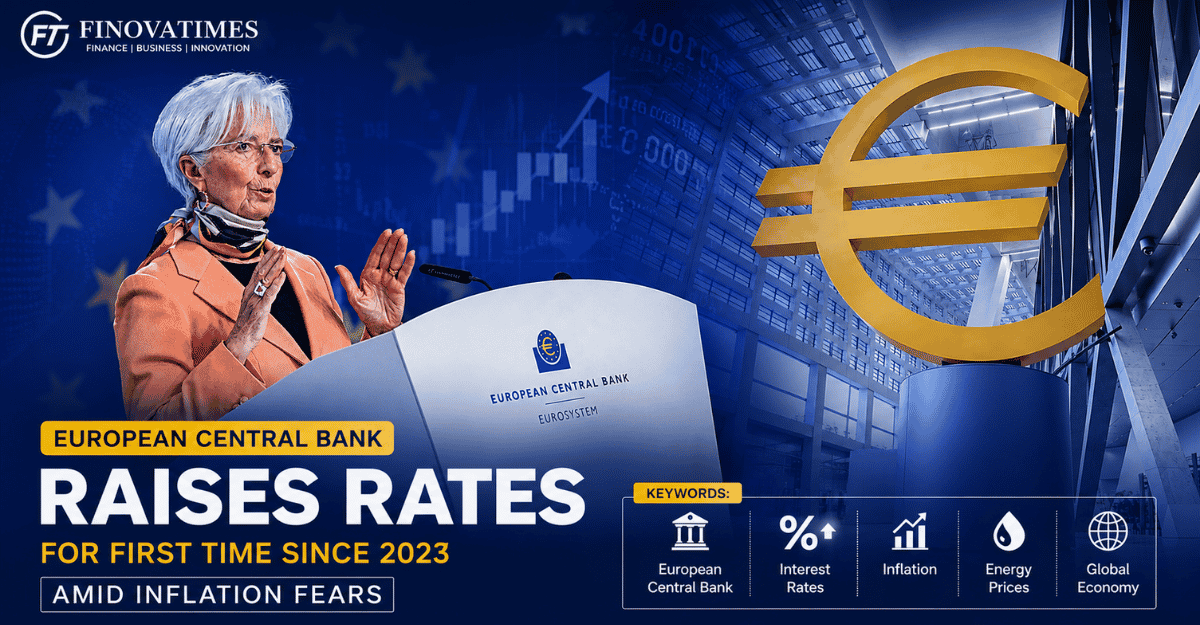
ECB Interest Rate Hike raises borrowing costs as inflation climbs above target. Learn what it means for Europe’s economy, markets, and global
ECB Interest Rate Hike Signals Tough Fight Against Inflation in Europe
The European Central Bank (ECB) has once again moved to tighten monetary policy, announcing an expected increase in interest rates as inflationary pressures continue to rise across the euro area. The latest ECB Interest Rate Hike comes at a critical time when energy prices are surging due to escalating geopolitical tensions in the Middle East, creating fresh concerns about inflation and economic stability throughout Europe.
For investors, businesses, and consumers around the world—including those in the United States—the ECB’s decision offers an important signal about how major central banks are responding to global inflation risks.
ECB Interest Rate Hike Comes Amid Rising Energy Costs
One of the biggest drivers behind the ECB’s latest policy move is the sharp increase in oil and natural gas prices. Ongoing conflict in the Middle East has disrupted energy markets and pushed costs higher, creating additional pressure on European households and businesses.
Inflation across the eurozone recently climbed above 3%, significantly exceeding the ECB’s long-term target of 2%. Policymakers worry that if higher energy prices remain elevated for an extended period, inflation could spread into wages, services, and consumer goods, making price increases more difficult to control.
By implementing another ECB Interest Rate Hike, officials hope to prevent inflation expectations from becoming permanently embedded in the economy.
Why Higher Interest Rates Matter
Interest rates influence nearly every part of the economy. When central banks raise rates:
Borrowing becomes more expensive.
Mortgage and loan costs increase.
Consumer spending may slow.
Business investment can decline.
Inflationary pressures are reduced over time.
The ECB believes that maintaining price stability is essential for long-term economic health, even if tighter financial conditions temporarily slow growth.
Following the latest decision, the ECB’s benchmark deposit rate rises to 2.25%, while the main refinancing rate increases to 2.40%.
Inflation Forecasts Remain Elevated
The central bank also revised its inflation outlook upward, indicating that policymakers expect price pressures to remain stronger than previously anticipated.
According to updated projections:
2026 inflation forecast increased to 3.0%.
Previous estimate was 2.6%.
2027 inflation forecast increased to 2.3%.
ECB target remains 2%.
These revisions suggest that inflation could remain above target for several years, reinforcing the need for a cautious but firm monetary policy stance.
The updated projections were one of the strongest justifications behind the latest ECB Interest Rate Hike.
Economic Growth Concerns Continue
While inflation remains a major concern, Europe is also facing slower economic growth.
The ECB reduced its 2026 growth forecast to 0.8%, down from 0.9% projected earlier. Growth for 2027 is expected to remain modest at around 1.2%.
This creates a difficult balancing act for policymakers.
Raise rates too aggressively, and economic activity could weaken further. Move too slowly, and inflation may remain elevated for longer than desired.
As a result, future policy adjustments are expected to remain gradual rather than aggressive.
Read more: Verizon DBIR Report Shows Rise in Software Vulnerability Attacks
What This Means for Global Markets
Although the ECB’s decisions primarily affect Europe, the impact often extends far beyond the region.
For U.S. investors, several developments are worth monitoring:
Currency markets could experience increased volatility.
European borrowing costs may continue rising.
Global bond yields could face upward pressure.
International companies operating in Europe may see changing financing conditions.
Energy market developments could influence inflation trends worldwide.
Financial markets currently expect additional rate increases over the next year if inflation remains stubbornly high.
All Eyes on ECB Leadership
Investors are now closely watching comments from ECB President Christine Lagarde and newly inaugurated Vice President Boris Vujčić.
Their guidance regarding future inflation risks, economic growth, and potential policy actions will likely shape market expectations for the remainder of the year.
Any indication that inflation is proving more persistent than expected could increase the likelihood of additional rate hikes in upcoming meetings.
ECB Interest Rate Hike Conclusion.
The latest ECB Interest Rate Hike highlights the growing challenge facing European policymakers as they attempt to control inflation without pushing the economy into recession. Rising energy prices, geopolitical uncertainty, and slowing growth have created one of the most complex economic environments in recent years.
While the ECB remains committed to restoring price stability, the path forward is far from certain. For global investors and businesses, future inflation data and ECB policy signals will remain key indicators to watch in the months ahead.
Source References. This report is based on publicly available information from the European Central Bank (ECB), market data, inflation projections, and reporting originally published by Reuters. FinovaTimes has independently rewritten, expanded, and analyzed the information for educational and informational purposes.
Related news: Anthropic Confidential IPO Filing 2026 Nears Wall Street Debut
European Commission Economic Forecasts – https://economy-finance.ec.europa.eu

Abdul Rehman is the founder and editor of FinovaTimes a digital-first financial media platform covering global markets, artificial intelligence, investing, business, and economic trends.
With a strong focus on modern financial journalism and data-driven storytelling, he specializes in translating complex market developments into clear, accessible insights for a global audience. His editorial work spans AI innovation, Wall Street trends, stock market analysis, macroeconomics, and emerging technologies shaping the future of finance.
Under his leadership, FinovaTimes has developed a modern newsroom approach inspired by leading global financial media brands, combining real-time reporting, high-impact digital publishing, and audience-focused financial content.
His work emphasizes clarity, credibility, and forward-looking analysis across the rapidly evolving global economy.