Abdul Rehman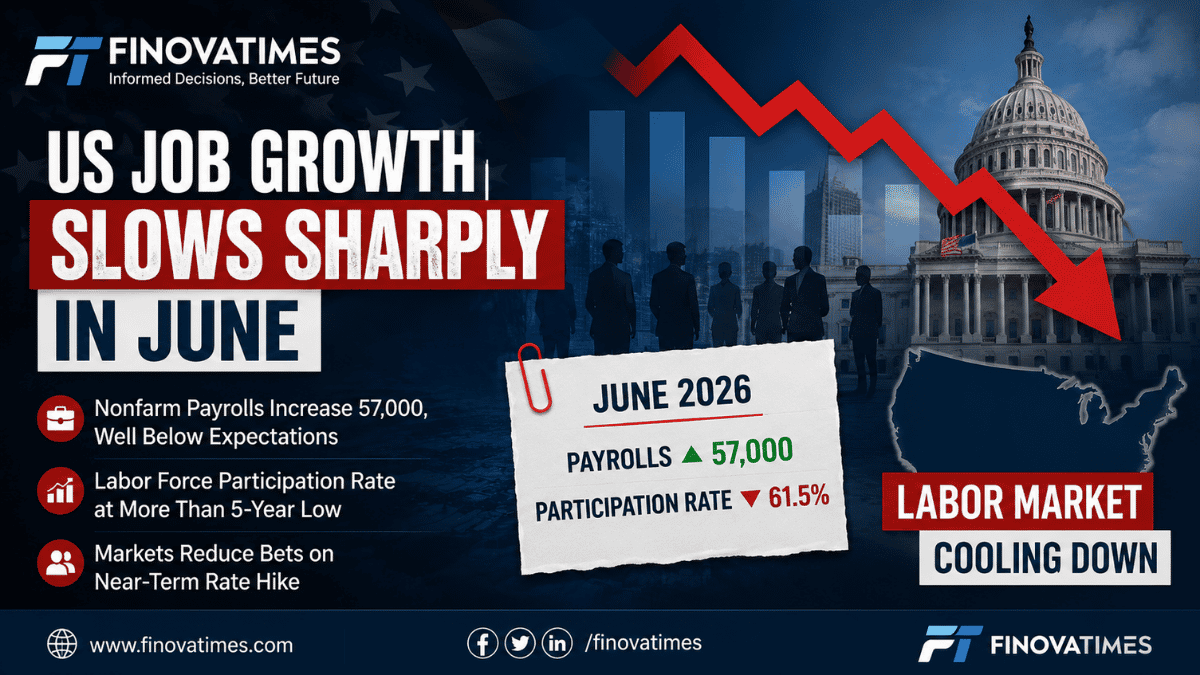
US Job Growth Slows June 2026 as nonfarm payrolls rose just 57,000 while labor force participation fell to a five-year low.
US Job Growth Slows June 2026 as Payroll Gains Miss Forecast
US Job Growth Slows June 2026 as the latest employment report showed a much weaker labor market than economists had expected. The U.S. economy added only 57,000 nonfarm jobs in June, significantly below the market forecast of 110,000 jobs. The weaker hiring numbers, combined with downward revisions to previous months, suggest that the labor market is gradually losing momentum.
According to the U.S. Labor Department, payroll gains for April and May were revised lower by a combined 74,000 jobs, further reinforcing signs of slower employment growth. Despite the disappointing hiring figures, the unemployment rate edged down from 4.3% to 4.2%, largely because hundreds of thousands of people exited the labor force rather than because of stronger job creation.
Labor Force Participation Falls to Five-Year Low
One of the biggest highlights of the report was the decline in the labor force participation rate. It dropped from 61.8% in May to 61.5% in June, marking its lowest level since March 2021.
Around 720,000 people left the labor force during the month, reducing the number of Americans actively working or looking for jobs. Economists believe this decline played a major role in lowering the unemployment rate despite weak hiring.
The employment-to-population ratio also slipped to 59.0%, reflecting softer labor market conditions.
Check out our Inflation News to learn how the ongoing price increases have influenced the world economy and affected Fed decisions.
Nonfarm Payrolls Miss Expectations
The June jobs report showed that the U.S. economy created only 57,000 jobs, nearly half of what analysts had predicted.
Although job creation slowed sharply, employment growth during the second quarter still averaged 111,000 jobs per month, considerably stronger than the same period last year. However, the latest figures indicate that hiring has become more cautious as businesses deal with economic uncertainty.
Many analysts believe companies are continuing a “low hiring, low firing” strategy, choosing to retain workers while slowing new recruitment.
Hospitality Sector Records Biggest Decline
The leisure and hospitality sector experienced the largest employment losses in June.
The industry lost 61,000 jobs, the biggest monthly decline since late 2020. Restaurants and bars shed nearly 33,000 positions, while hotels and motels cut more than 21,000 jobs.
Economists linked the slowdown to weaker consumer spending after higher fuel prices earlier this year reduced household budgets. Although gasoline prices have eased recently, they remain above pre-conflict levels, limiting discretionary spending on travel and dining.
Get the latest information about the world markets and economic and corporate news from our Business News section.
Healthcare and Professional Services Continue Hiring
While several sectors weakened, some industries continued to add jobs.
Professional and business services created 36,000 jobs, making it the strongest-performing sector during the month. Social assistance employment increased by 25,000, while healthcare added 22,000 new positions.
Construction employment rose by 11,000 jobs, manufacturing added 3,000, and government payrolls increased by 8,000.
Meanwhile, retail employment declined by 7,500 jobs, and the information sector lost 9,000 positions.
What This Means for the Federal Reserve
The weaker employment report has influenced market expectations regarding future interest rate decisions.
Following the release of the data, investors reduced expectations that the Federal Reserve would raise interest rates in the near term. Markets now expect policymakers to keep rates unchanged in the coming meeting while closely monitoring inflation and labor market conditions.
However, many economists argue that the labor market remains relatively stable because layoffs continue to stay historically low. Wage growth also remained steady, with average hourly earnings increasing 3.5% year over year, although inflation continues to outpace wage growth.
Outlook for the US Economy
The latest employment report suggests that the U.S. labor market is cooling rather than collapsing.
Hiring has slowed, labor force participation has weakened, and several service industries are showing signs of softer demand. At the same time, low layoffs and continued hiring in healthcare and professional services indicate that the economy still has areas of resilience.
The coming months will be closely watched by investors and policymakers to determine whether the slowdown is temporary or the beginning of a broader cooling trend for the U.S. economy.
FAQ
1. What happened in the June 2026 US jobs report?
The U.S. economy added only 57,000 jobs, well below expectations of 110,000.
2. Why did the unemployment rate fall?
The unemployment rate declined to 4.2% mainly because about 720,000 people left the labor force.
3. What is the labor force participation rate?
It measures the percentage of working-age people who are employed or actively seeking work. It fell to 61.5%, the lowest level in over five years.
4. Will the Federal Reserve raise interest rates?
Markets now expect the Federal Reserve to keep interest rates unchanged in the near term while monitoring inflation and employment data.
Editorial Note
This report is based on the recently released employment numbers provided by the U.S. Bureau of Labor Statistics and other available market data. FinovaTimes provides independent reporting to inform readers about important economic events and their potential impact on global markets.
Disclaimer: The information presented in this article is provided for informational and educational purposes only. Although every effort was made to provide accurate information at the time of writing, economic data and market environment can be subject to change. Please, verify information before taking any investment actions.
Source: Reuters, U.S. Bureau of Labor Statistics (BLS), Federal Reserve.

Abdul Rehman is the founder and editor of FinovaTimes a digital-first financial media platform covering global markets, artificial intelligence, investing, business, and economic trends.
With a strong focus on modern financial journalism and data-driven storytelling, he specializes in translating complex market developments into clear, accessible insights for a global audience. His editorial work spans AI innovation, Wall Street trends, stock market analysis, macroeconomics, and emerging technologies shaping the future of finance.
Under his leadership, FinovaTimes has developed a modern newsroom approach inspired by leading global financial media brands, combining real-time reporting, high-impact digital publishing, and audience-focused financial content.
His work emphasizes clarity, credibility, and forward-looking analysis across the rapidly evolving global economy.