Abdul Rehman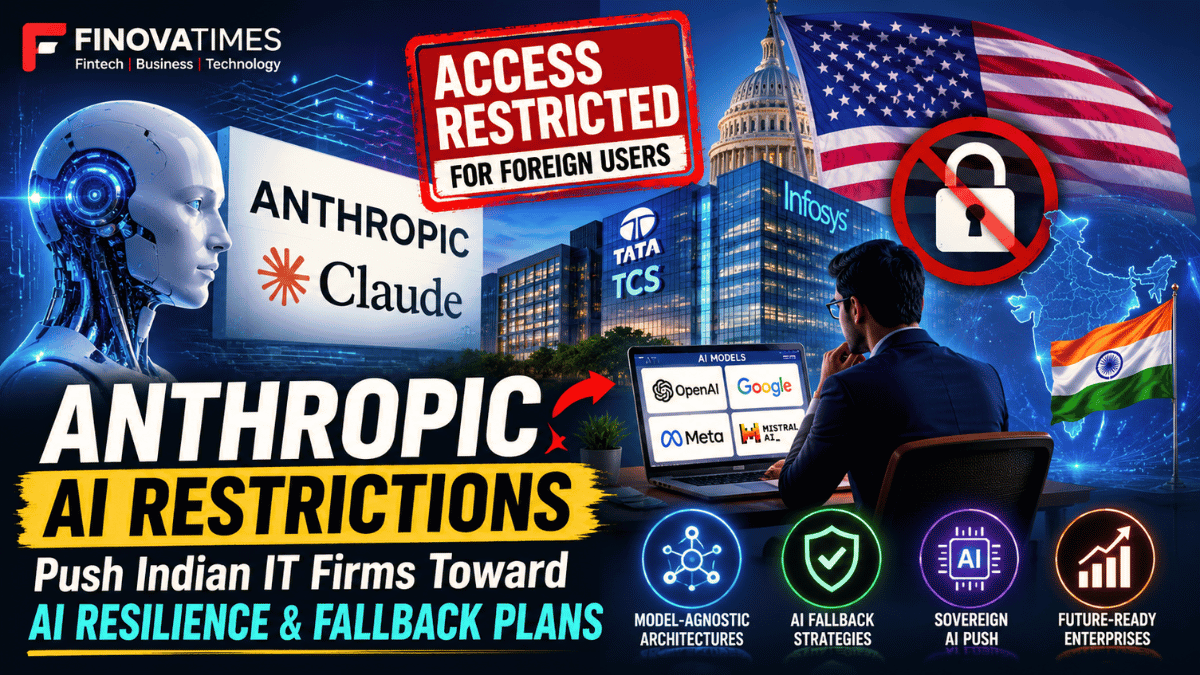
Anthropic AI Restrictions are forcing Indian IT firms to adopt model-agnostic AI architectures, fallback strategies, and sovereign AI alternatives.
Anthropic AI Restrictions Push Indian IT Firms Toward AI Resilience
The recent Anthropic AI Restrictions imposed by the United States government are creating new challenges for global technology companies, especially India’s fast-growing IT services sector. The move has raised concerns about relying too heavily on a single AI provider and is pushing enterprises to rethink how they build and deploy artificial intelligence solutions.
For years, large IT firms have partnered with leading AI companies to deliver advanced solutions for clients across industries. However, recent restrictions on access to Anthropic’s advanced AI models have highlighted a major risk: what happens when access to a critical AI model is suddenly limited due to geopolitical decisions?
Why Anthropic AI Restrictions Matter
Anthropic recently received a directive requiring the company to suspend access to certain advanced AI models for foreign nationals. The decision has sent shockwaves through the technology industry because many organizations have integrated these models into their AI workflows, applications, and enterprise solutions.
The timing is particularly significant because several major Indian IT companies recently expanded their partnerships with Anthropic. As organizations invest heavily in AI transformation projects, unexpected access limitations can disrupt planning, development, and long-term innovation strategies.
For enterprise customers, the issue goes beyond technology. It raises questions about reliability, compliance, business continuity, and operational risk.
Read more: Michael Truell SpaceX Deal: 25-Year-Old CEO Sells Cursor for $60 Billion
Indian IT Firms Are Shifting Toward Model-Agnostic AI
The biggest lesson from the current situation is that businesses can no longer depend on a single AI model provider.
Technology leaders are increasingly adopting a model-agnostic approach, where applications are designed to work with multiple AI models instead of relying on one platform. This allows companies to switch providers quickly if restrictions, outages, pricing changes, or regulatory issues occur.
Under this approach, organizations can integrate models from providers such as OpenAI, Google, Meta, Mistral, AWS, and emerging regional AI companies while maintaining consistent user experiences.
This flexibility reduces operational risk and ensures that client projects continue running even if access to a particular model becomes unavailable.
AI Fallback Plans Are Becoming Essential
Another major trend emerging from the Anthropic AI Restrictions is the growing importance of AI fallback strategies.
Instead of deploying a single AI model, companies are now building systems that automatically shift workloads to alternative models when necessary. These fallback mechanisms help maintain service continuity and reduce disruption.
To achieve this, firms must:
Test multiple AI models for the same use case
Create backup AI workflows
Build flexible prompt engineering frameworks
Develop reusable retrieval-augmented generation (RAG) systems
Implement stronger governance and monitoring controls
As AI becomes more deeply integrated into business operations, resilience is becoming just as important as performance.
The Rise of Sovereign AI and Open-Source Models
The restrictions are further fueling the development of sovereign AI initiatives and open source solutions.
Many organizations now see value in reducing dependence on foreign frontier AI models. Open-source models offer greater transparency, customization, and control over deployment environments.
Countries around the world are investing in domestic AI capabilities to ensure long-term technological independence. India is also increasing support for local AI development as part of its broader digital innovation strategy.
Industry experts believe that sovereign AI ecosystems could become a critical component of national technology infrastructure in the coming years.
New Opportunities for IT Service Providers
While the restrictions create challenges, they also open new business opportunities.
Rather than serving only as implementation partners, IT companies can position themselves as AI resilience architects. Their role will go beyond using AI models to developing systems that will continue functioning irrespective of the model used to provide the solutions.
Future enterprise AI projects will likely require:
Model portability
Vendor diversification
AI governance frameworks
Compliance monitoring
Jurisdiction-aware deployments
Advanced security controls
These companies can get a competitive edge in the ever-changing AI landscape if they can harness these skills.
Implications for the Future of Enterprise AI
The Anthropic AI Restrictions represent a turning point for the enterprise AI market. Businesses are realizing that AI success depends not only on accessing powerful models but also on building flexible and resilient architectures.
As geopolitical risks, regulations, and market dynamics continue to evolve, organizations will increasingly prioritize adaptability over dependence on any single provider.
For Indian IT firms and global enterprises alike, the future of AI will likely be defined by multi-model strategies, open ecosystems, and stronger resilience planning.
Conclusion
The impact of Anthropic AI Restrictions extends far beyond one company or one market. It highlights the growing importance of AI diversification, model portability, and long-term resilience planning.
As enterprises adapt to this new reality, the focus is shifting from choosing the best AI model to building systems capable of working with many models. Companies that embrace model-agnostic architectures and robust fallback strategies will be better positioned to navigate future disruptions and maintain a competitive edge in the rapidly evolving AI economy.
Source: FinovaTimes analysis based on publicly available reports and industry commentary. Key information referenced from Moneycontrol.
Editorial Disclaimer: The above article is provided for informational purposes only. The views and analysis presented are based on publicly available information and expert commentary available at the time of publication. Readers should conduct their own research before making business, investment, or technology-related decisions.
Why This Matters
The Anthropic restrictions highlight a growing challenge for enterprises worldwide: dependence on a single AI provider. As organizations invest billions in artificial intelligence, flexibility, resilience, and sovereign AI capabilities are becoming critical strategic priorities.
Read more: Anthropic Confidential IPO Filing 2026 Nears Wall Street Debut.

Abdul Rehman is the founder and editor of FinovaTimes a digital-first financial media platform covering global markets, artificial intelligence, investing, business, and economic trends.
With a strong focus on modern financial journalism and data-driven storytelling, he specializes in translating complex market developments into clear, accessible insights for a global audience. His editorial work spans AI innovation, Wall Street trends, stock market analysis, macroeconomics, and emerging technologies shaping the future of finance.
Under his leadership, FinovaTimes has developed a modern newsroom approach inspired by leading global financial media brands, combining real-time reporting, high-impact digital publishing, and audience-focused financial content.
His work emphasizes clarity, credibility, and forward-looking analysis across the rapidly evolving global economy.