Abdul Rehman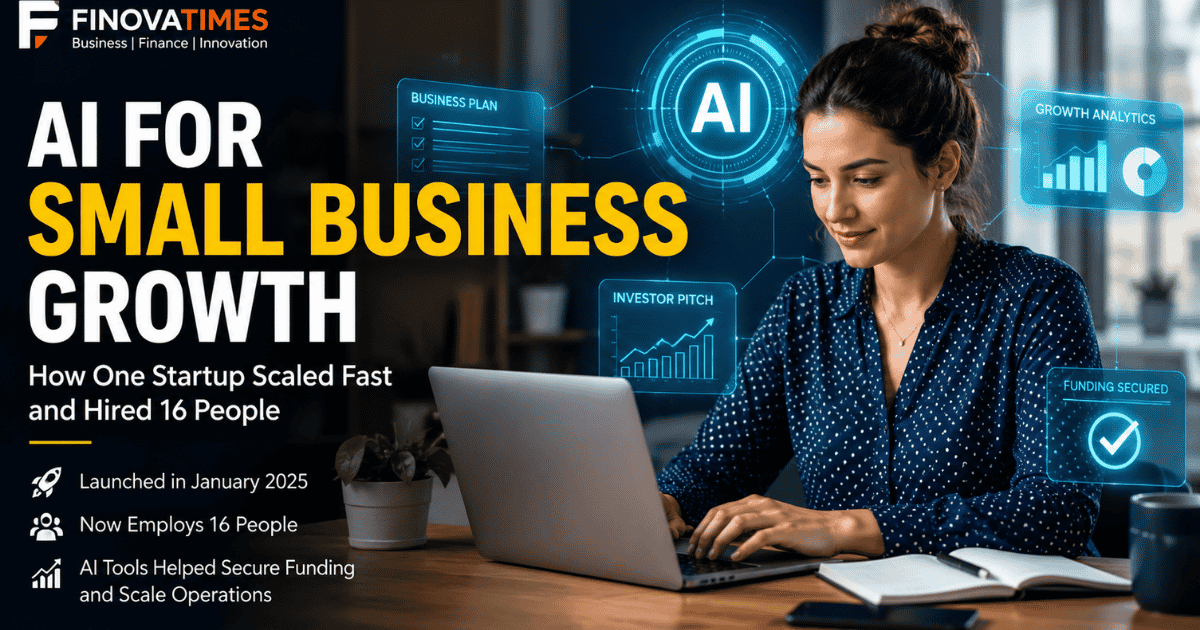
AI for Small Business Growth helped a startup launch quickly, attract investors, expand to 16 employees, and reshape entrepreneurship.
How One Startup Turned an Idea Into a Fast-Growing Company
Artificial intelligence is changing more than just the technology sector. AI for Small Business Growth is now helping entrepreneurs launch companies faster, reduce costs, and scale operations with limited resources.
A growing example is Here Now Health, a U.S.-based mental health startup that transformed a simple idea into a rapidly expanding business with the support of AI-powered tools. While economists continue debating AI’s long-term impact on jobs, stories like this highlight how the technology is already helping small businesses grow.
AI for Small Business Growth Helped Launch a Startup Faster
Here Now Health officially launched in January 2025 with a mission to improve mental health services for children entering the foster care system.
The company was founded by Michelle Turner, a foster parent who identified a major gap in mental healthcare for vulnerable children. Instead of relying on a large team or expensive consultants, Turner used AI tools to speed up nearly every stage of building the business.
She used AI to:
Learn startup fundamentals
Prepare a professional business plan
Improve investor presentations
Practice fundraising pitches
Organize business strategies
This allowed the company to move from an idea to an operational business in a much shorter time than many traditional startups.
From First-Time Founder to Business Leader
Michelle Turner had never launched a startup before.
She was also raising six children while building the company and did not have a business school background or an MBA. According to Turner, AI became a virtual business coach that helped her understand complex startup concepts and improve her confidence during fundraising.
The support proved valuable as investors began backing the business.
Today, Here Now Health employs 16 people and is certified in three U.S. states to provide Medicaid-funded mental health counseling for children entering foster care.
Why AI for Small Business Growth Is Getting More Attention
Success stories like Here Now Health are becoming increasingly common.
Business experts say AI is reducing the cost of launching a company by automating tasks that previously required expensive consultants, designers, researchers, or marketing specialists.
Entrepreneurs can now complete many business activities within hours instead of weeks, including:
Market research
Business planning
Content creation
Presentation design
Customer communication
Administrative work
Lower startup costs are encouraging more people to start businesses while allowing small teams to compete more effectively.
The Federal Reserve Is Closely Watching AI
The rapid expansion of AI has also attracted the attention of the U.S. Federal Reserve.
Officials are studying how artificial intelligence could influence:
Productivity
Economic growth
Inflation
Employment
Long-term business investment
Higher productivity could help the economy grow faster while keeping inflation under control. However, economists also acknowledge that automation may reduce the number of workers needed for certain tasks.
Because of these possibilities, AI remains one of the biggest economic topics in the United States.
Read more: AI Jobs in America 2026: How Artificial Intelligence Is Changing White-Collar Work
AI Could Create Opportunities and Challenges
Many economists believe AI for Small Business Growth can create new opportunities while also changing the job market.
Supporters argue that AI helps businesses expand more quickly, which can eventually lead to additional hiring.
Others warn that some office-based roles, administrative jobs, and routine clerical positions could become increasingly automated.
Rather than eliminating every job, many experts expect AI to reshape how people work by automating repetitive tasks while increasing demand for higher-value skills.
Small Businesses May Benefit the Most
Technology advisors believe small businesses stand to gain the most from AI.
Instead of spending thousands of dollars on consultants or software, entrepreneurs can now access affordable AI tools for planning, writing, marketing, customer service, and productivity.
This allows founders to focus more on growing their businesses and serving customers instead of handling repetitive administrative work.
For many startups, AI is becoming an assistant rather than a replacement for human workers.
The Future of AI for Small Business Growth
Despite growing optimism, experts agree that the transition will not be simple.
Previous technological shifts changed entire industries and displaced many workers before new opportunities emerged. AI could create a similar period of adjustment, especially for occupations involving repetitive office tasks.
At the same time, businesses facing worker shortages may use AI to increase employee productivity instead of reducing staff.
The overall impact will likely depend on how quickly businesses adopt AI and how workers adapt by learning new skills.
Explore more: Anthropic AI Restrictions Push Indian IT Firms Toward AI Resilience
Final Thoughts
The story of Here Now Health demonstrates that AI for Small Business Growth is already making a real difference outside the technology industry.
By helping entrepreneurs learn faster, prepare stronger business plans, and reduce startup costs, AI is opening new opportunities for founders with limited resources.
While questions remain about AI’s long-term effect on employment, one trend is becoming increasingly clear: businesses that learn to use AI effectively may gain a significant competitive advantage in the years ahead.
Source: Reporting based on information published by Reuters, with additional editorial rewriting and analysis by FinovaTimes.
Related: AI Impact 2026: The Biggest Technology Shift Yet

Abdul Rehman is the founder and editor of FinovaTimes a digital-first financial media platform covering global markets, artificial intelligence, investing, business, and economic trends.
With a strong focus on modern financial journalism and data-driven storytelling, he specializes in translating complex market developments into clear, accessible insights for a global audience. His editorial work spans AI innovation, Wall Street trends, stock market analysis, macroeconomics, and emerging technologies shaping the future of finance.
Under his leadership, FinovaTimes has developed a modern newsroom approach inspired by leading global financial media brands, combining real-time reporting, high-impact digital publishing, and audience-focused financial content.
His work emphasizes clarity, credibility, and forward-looking analysis across the rapidly evolving global economy.